All about the practical experience
New Professional Program

Are you on the right page?
This page provides information about the practical experience for candidates enrolled in the new CPA Professional Program, which will be offered from 2027.
If you’re registered in the current CPA Professional Education Program or plan to register between now and December 2026, refer to the practical experience page for that program.
What is CPA practical experience?
Practical experience is much more than just a requirement on your path to becoming a CPA. It’s where you bring your competencies to life and transform theory into practice.
Based on the practical experience competency assessment grid, practical experience leading to CPA designation is paid and lasts a minimum of 24 months. It allows you to apply what you’ve learned and gives you the opportunity to develop your professional judgement and competencies in real situations that are nuanced and increasingly complex.
No matter what your goals are, practical experience opens the door to the business world in the field of your choice:
- Companies
- Firms
- Public and parapublic sector
- Non-profit organizations
Are you familiar with the rules governing your practical experience?
Our administrative policies specify the conditions you must adhere to throughout your experience.
Take the time to read them to get off to a good start.
A new practical experience framework for the competencies of today and tomorrow
Being a CPA is about more than just mastering concepts. It’s also about using your judgment and applying your competencies to help organizations thrive, build stronger communities, and create a more sustainable future.
There are a number of crucial competencies in addition to financial reporting and management accounting, which are core to the profession. Being a CPA means going beyond numbers and adapting to the ever-changing business landscape.
It also involves:
- employing professional skepticism,
- making ethical decisions,
- communicating clearly and impactfully.
Areas of competency development
There are eight main training areas in which you may demonstrate your competencies during your practical experience. Choose the area that best aligns with your dream career.
Financial Reporting
The role must contribute to the financial reporting of an organization and not be clerical. It must not be limited to pulling data and must be within a standards-based framework.
Examples :
- Needs and systems
- Accounting policies and transactions
- Financial report preparation
- Financial statement analysis
Management Accounting
The role must contribute to the management decision making of an organization and must not be limited to pulling data.
Examples :
- Needs and systems
- Planning, budgeting, and forecasting
- Cost and profitability management
- Organizational/individual performance measurement
Assurance & Trust
The role must contribute to an assurance or trust engagement of an organization and must not be clerical. It must not be limited to pulling data and must be within a standards-based framework.
Examples :
- Internal control
- Internal audit or external assurance requirements, basis, and risk assessment
- Internal audit projects or external assurance engagements
Finance
The role must contribute to the financial management of an organization. It must not be clerical and must not be limited to pulling data.
Examples :
- Financial analysis and planning
- Treasury management
- Capital budgeting, evaluation, and corporate finance
Taxation
The role must contribute to the taxation compliance/planning of an organization or individual and must not be clerical. It must not be limited to pulling data and must be within a standards-based framework.
Examples :
- Income tax legislation and research
- Tax compliance: corporate or personal
- Tax planning: corporate or personal
Strategy or Governance
The role must contribute to the strategy or governance of an organization and must not be clerical. It must not be limited to pulling data.
Examples :
- Governance, mission, vision, values, and mandate
- Strategy development/implementation
- Enterprise risk management
Non-Financial Reporting
The role must contribute to the non-financial reporting of an organization and must not be clerical. It must not be limited to pulling data and must be within a standards-based framework.
Examples :
- ESG reporting
- Monitoring regulatory and interested parties requirements
- Developing and monitoring reporting framework
Big Data
The role must contribute to the analysis and processing of data and must not be clerical. It must not be limited to pulling data.
Examples :
- Data analysis
- Building of KPIs
Practical experience that prepares you for the job market
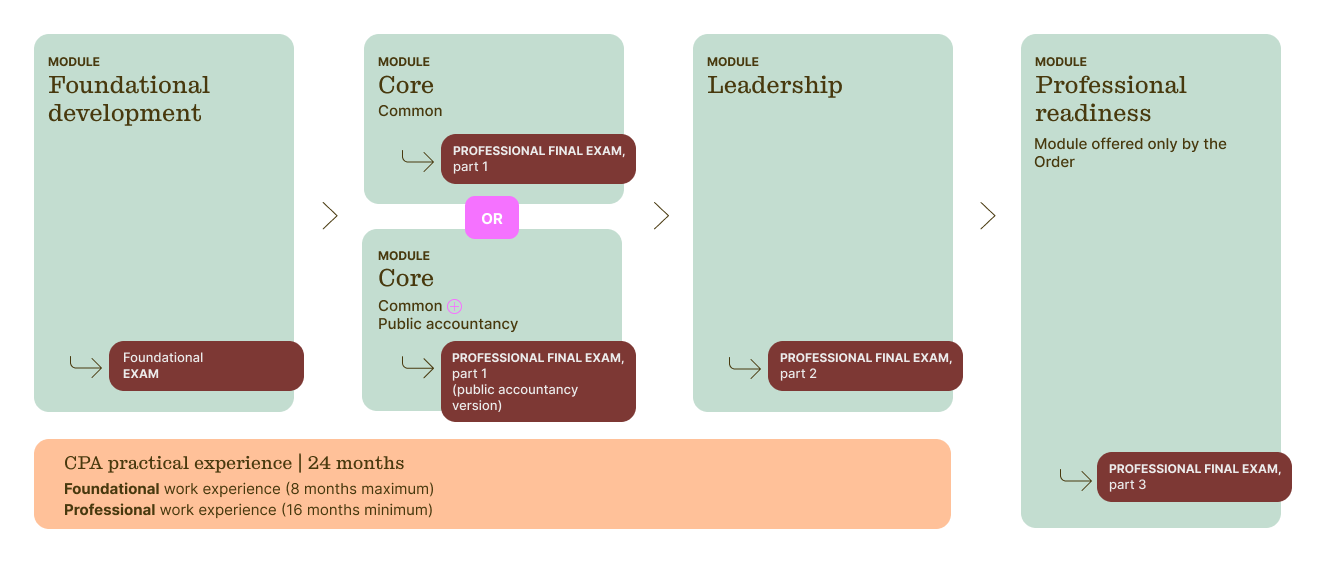
To become a CPA, you must complete 24 months of experience recognized by the Order, performing tasks that are increasingly advanced in order to gradually develop your competencies.
Foundational work experience
Foundational work experience acquired before you register with the Order OR after may be recognized. Up to 8 months in total is permitted. This type of work experience is not mandatory. In fact, all 24 months of experience may be recognized as professional work experience, if the entire practical experience is completed after registering with the Order and depending on the competencies you expect to develop. Note that practical experience completed before registering with the Order may only be recognized as foundational work experience.
This type of experience is defined by the level of competencies demonstrated. It develops skills in line with the fundamentals of the CPA profession.
While this type of experience may be acquired in roles with fewer responsibilities, it must include situations that require decision making and the application of professional judgment. It therefore must not be limited to administrative or clerical tasks.
Professional work experience
Professional work experience may only be acquired after you register with the Order. You must complete at least 16 months of professional work experience, but the 24 months of recognized experience may consist entirely of professional work experience.
This type of experience is defined by the level of competencies demonstrated. It develops the skills you’ll need to join the CPA profession as a fully competent professional.
This type of experience helps candidates consolidate their knowledge, develop autonomy and professional judgment, take on more strategic analyses, and acquire decision-making competencies in complex situations.
By progressing as a professional and developing competencies throughout your experience, you’ll demonstrate to the Order that you meet the requirements of CPA practical experience.
Warning
The type of experience that is recognized is determined by the Order’s analysis of your practical experience report at the end of your experience, based on the competencies you have developed and demonstrated.
Before you may take the Professional Readiness module and Part 3 of the Professional Final Exam, you must complete your practical experience and have it recognized by the Order.
A streamlined monitoring process
The practical experience monitoring process has been redesigned and is now simpler and more straightforward. The Order now monitors experience only at the beginning and end of the practical experience period using two key tools: the work plan and the practical experience report.
This approach allows the Order to compare your anticipated responsibilities with your actual responsibilities, as well as plan and assess the progression of your competencies.
Furthermore, it allows the Order to evaluate whether your experience can be recognized as foundational or professional work experience.

Important
In certain situations, the Order may require a monitoring process that differs from the one described here. The purpose of this approach is to support you throughout your journey and help you succeed. Closer monitoring may be implemented, for example, to ensure that your experience enables you to develop the required competencies and meet the practical experience requirements. If this applies to you, we will contact you to determine the monitoring arrangements that are best suited to your situation.
Mentorship
Mentorship provides a space for discussion in which you can take a step back and develop your professional judgment.
For practical experience completed after registering with the Order, a CPA Mentor must accompany you throughout your practical experience, be it foundational or professional.
Your CPA Mentor must:
- be a member in good standing of the Order and work in the same organization as you,
- provide you with coaching and feedback throughout your experience,
- approve your work plan,
- approve your experience reports, which attest to your progress and the development of your competencies.
Important
S’il n’y a aucun ou aucune CPA qui travaille dans l’organisation où vous souhaitez faire votre stage, vous pouvez demander à un ou une CPA de votre réseau d’agir à titre de mentor ou mentore.
Cela s’applique seulement aux stages ne menant pas à l’obtention du permis de comptabilité publique (titre de CPA auditeur ou auditrice).
Full-time and part-time practical experience
You may complete your practical experience on a full-time basis (minimum of 32 hours per week) or a part-time basis (minimum of 17.5 hours per week). In both cases, the total duration of the practical experience is 24 months. Part-time practical experience is calculated on a prorated basis based on a 32-hour work week. As such, your practical experience may take place over a period exceeding 24 months, depending on your schedule.
Practical experience acquired before registering with the Order
If you acquired practical experience before registering with the Order, a maximum of eight months of foundational work experience may be recognized.
To be recognized, this experience must:
- have been acquired after you earned a minimum of 30 university credits,
- have been acquired in the last five years,
- have been reported in your work plan,
- have been approved by a CPA in good standing at the same organization.
Obtaining CPA auditor designation
If you wish to obtain a public accountancy permit, which leads to this designation, your practical experience must meet certain requirements.
Visit the CPA auditor designation page for full details.
Practical experience outside Quebec
The Order recognizes practical experience that takes place outside Quebec or Canada if it fulfills the CPA competency development requirements.
Before you begin, you must ask the Order to confirm the experience’s eligibility. If you completed practical experience outside Quebec before registering with the Order, you may report it in your work plan so that we can assess its eligibility.
The following conditions must be met:
- The experience must meet the applicable program requirements and help you develop CPA competencies. If it is intended to qualify you for a public accountancy permit, the specific requirements for that permit must also be met.
- The experience must be supervised by a CPA Mentor who is a member of the CPA organization of a Canadian province or territory.
Depending on the nature of the practical experience and the pathway you are pursuing, the Order may require additional information or validation to confirm that the experience is eligible.
Act to ensure the protection of trainees in the workplace
Since August 24, 2022, trainees have benefited from increased protections due to amendments to the Act respecting labour standards. The Act to ensure the protection of trainees in the workplace grants trainees the following, under certain conditions:
- The right to be absent from the place of training during certain statutory general holidays
- The right to be absent from the place of training due to sickness or for family or parental reasons
- The right to a place of training free from psychological harassment, including such behaviour in the form of verbal comments, actions or gestures of a sexual nature
- Protection from reprisals from an employer, educational institution, professional order, or any of their agents for exercising a right
- Recourse to the Commission des normes, de l’équité, de la santé et de la sécurité du travail and the Administrative Labour Tribunal should one of their rights under the Act be infringed upon
For its part, the Order is required to take reasonable measures at its disposal to ensure that the trainee’s successful completion of experience or licensure is not compromised due to the exercise of a right set out in the Act.
Whether you’re a student, candidate for the practice of the profession, Mentor, program leader, manager, or partner in an organization that offers experience to candidates for the practice of the profession, you should familiarize yourself with these changes.
For more information on the rights of trainees and the obligations of persons overseeing them, please visit the CNESST page on trainee working conditions.
Recourse during your path to CPA designation
If you’re dissatisfied with how the Order has handled your candidacy at any stage on your path to CPA designation, you may share your comments with the Qualification Committee by emailing candidatCPA@cpaquebec.ca.
You may also file a complaint at no cost with the Commissioner for Admission to Professions, an independent government entity that receives and examines complaints pertaining to admission to professions. This includes complaints involving the Order or other organizations involved in your admission process, such as a university.

Questions?
Please feel free to contact us at stages@cpaquebec.ca to discuss your situation with our team. We will be happy to guide you.