CPA competencies
New Professional Program

Are you on the right page?
This page provides information on the practical experience competencies for candidates enrolled in the new CPA Professional Program, which will be offered from 2027.
If you’re registered in the current CPA Professional Education Program or plan to register between now and December 2026, refer to the practical experience competencies page for that program.
A competency refers to your ability to apply your knowledge, judgment, and skills in a real-world professional setting.
CPA practical experience lets you gradually develop the competencies expected of future CPAs so that you can analyze situations of increasing complexity and effectively communicate your findings and recommendations.

During your practical experience, you may develop CPA competencies across eight training areas. Learn more >
How are CPA competencies assessed?
The development of your competencies will be assessed at two key points: at the beginning of your practical experience in your work plan and in your practical experience report.
6 competency categories
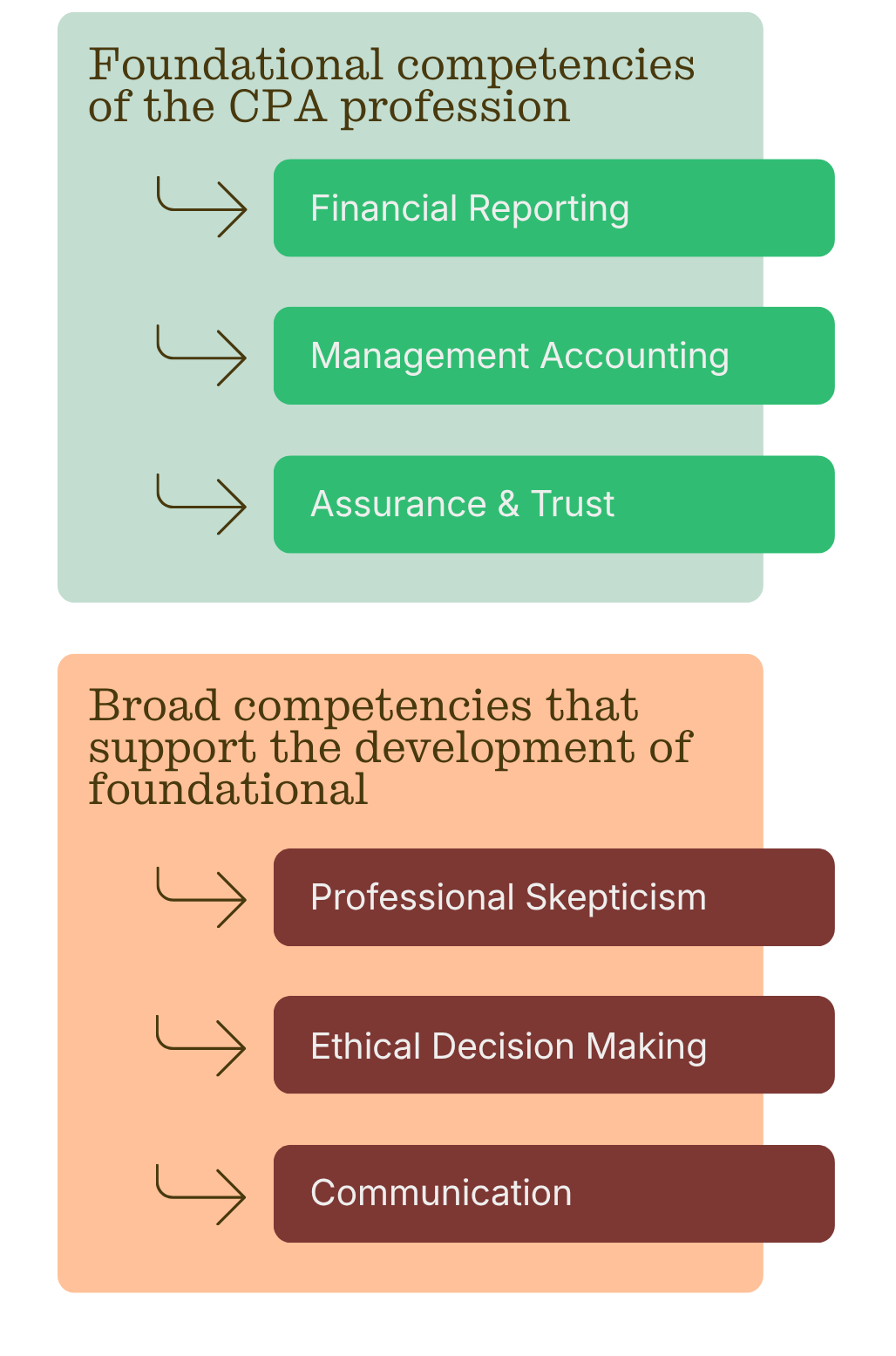
The CPA competencies that you’ll develop during your practical experience are organized into six categories.
Each category includes a certain number of tasks that define how competencies should be demonstrated in practice in your work.
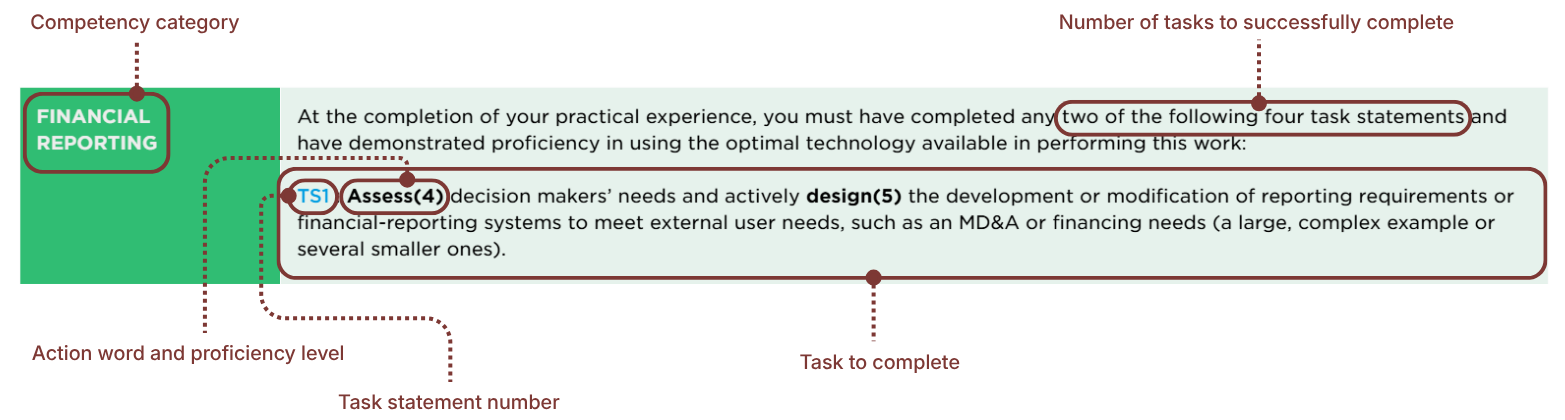
To conclude that you’ve developed the competencies in a category, the Order will verify that you’ve completed the required number of tasks for that category. For example, for the Financial Reporting category, you must complete at least two of the four listed tasks for that competency to be considered sufficiently developed.
Note that the categories of competencies to develop differ depending on the designation you wish to obtain (CPA designation or CPA auditor designation).
5 levels of proficiency
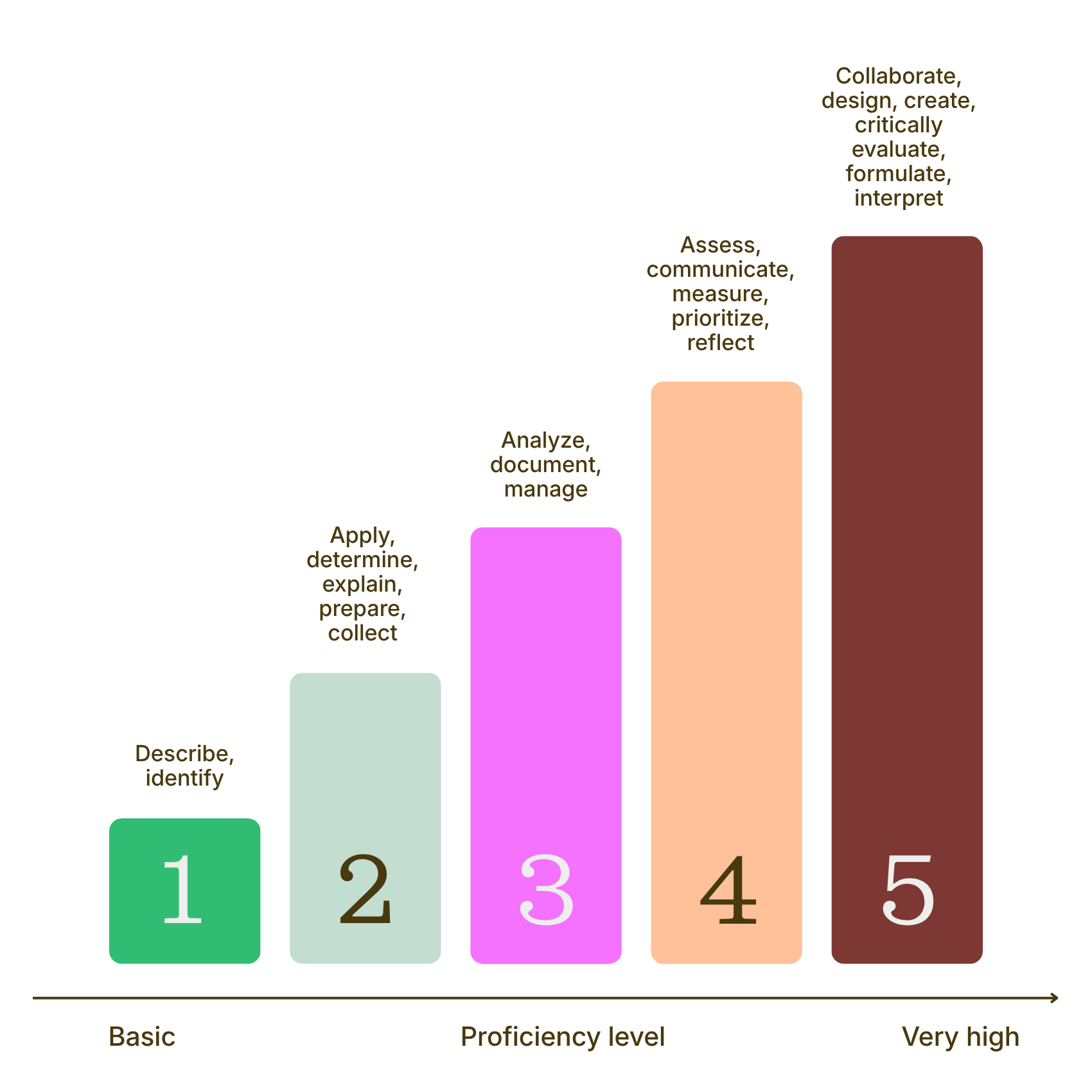
Each task statement (TS) is associated with a level of proficiency on a scale of one to five for the competency in question. The action word used in each statement reflects the proficiency level and clearly establishes the expected level for each task. The more complex the action, the higher the expected proficiency level.
Your proficiency level itself is not assessed, but rather your ability to successfully complete the task outlined in the statemen.
Example
Here’s an example to help explain how the practical experience competency assessment grid below is designed:
Recognition and requirements of practical experience
When analyzing your work plan, the Order will determine whether your practical experience constitutes foundational work experience or professional work experience.
The type of work experience is determined based on:
- when it was acquired,
- the responsibilities associated with your role,
- the level of complexity of the situations you plan to encounter,
- the competencies you will be expected to develop.
Foundational work experience
A maximum of 8 months of practical experience may be recognized by the Order as foundational work experience (for practical experience completed before or after registering with the Order) if it has allowed, or will allow you to carry out all the following tasks:
TS1 : Prepare(2) or explain(2) information for input into internal or external reporting (e.g. financial statements, financial forecasts, financial budgets, management reports).
TS2 : Identify(1) the user's needs and prepare(2) practical alternatives or variance analyses that consider the impact on user's needs.
TS3 : Explain(2) your analyses and findings in a transparent, understandable and professional manner.
Professional work experience
A minimum of 16 months of practical experience may be recognized by the Order as professional work experience (only for practical experience completed after registering with the Order). At the completion of your practical experience, the Order’s analysis of your practical experience report will confirm whether you’ve properly developed the competencies needed to join the profession.
The competencies in which you must become proficient at the completion of your practical experience will differ depending on whether you wish to obtain a public accountancy permit (CPA auditor designation).
Practical experience leading to CPA designation
If you wish to obtain the CPA designation, you must demonstrate your competencies in the following categories :
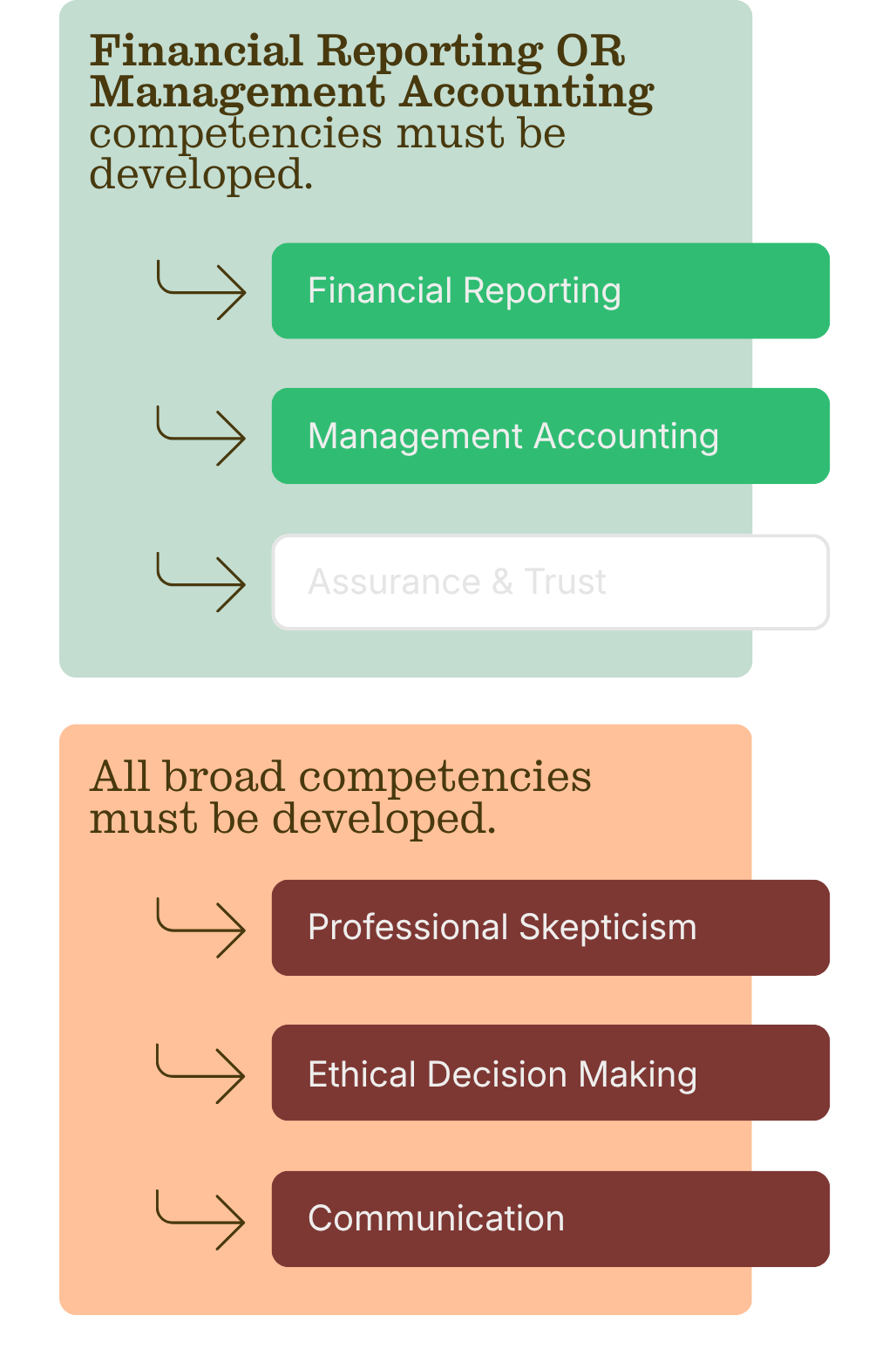
Depending on the nature of your role, you may develop competencies in both Financial Reporting AND Management Accounting. However, at a minimum, you must meet the requirements of one of these two categories, in addition to the broad competency requirements, for the Order to consider your practical experience a success.
For detailed requirements for each competency category and the tasks to complete, see the practical experience competency assessment grid.
Practical experience leading to the CPA auditor designation
If you wish to obtain a public accountancy permit, you must demonstrate your competencies in the following categories:
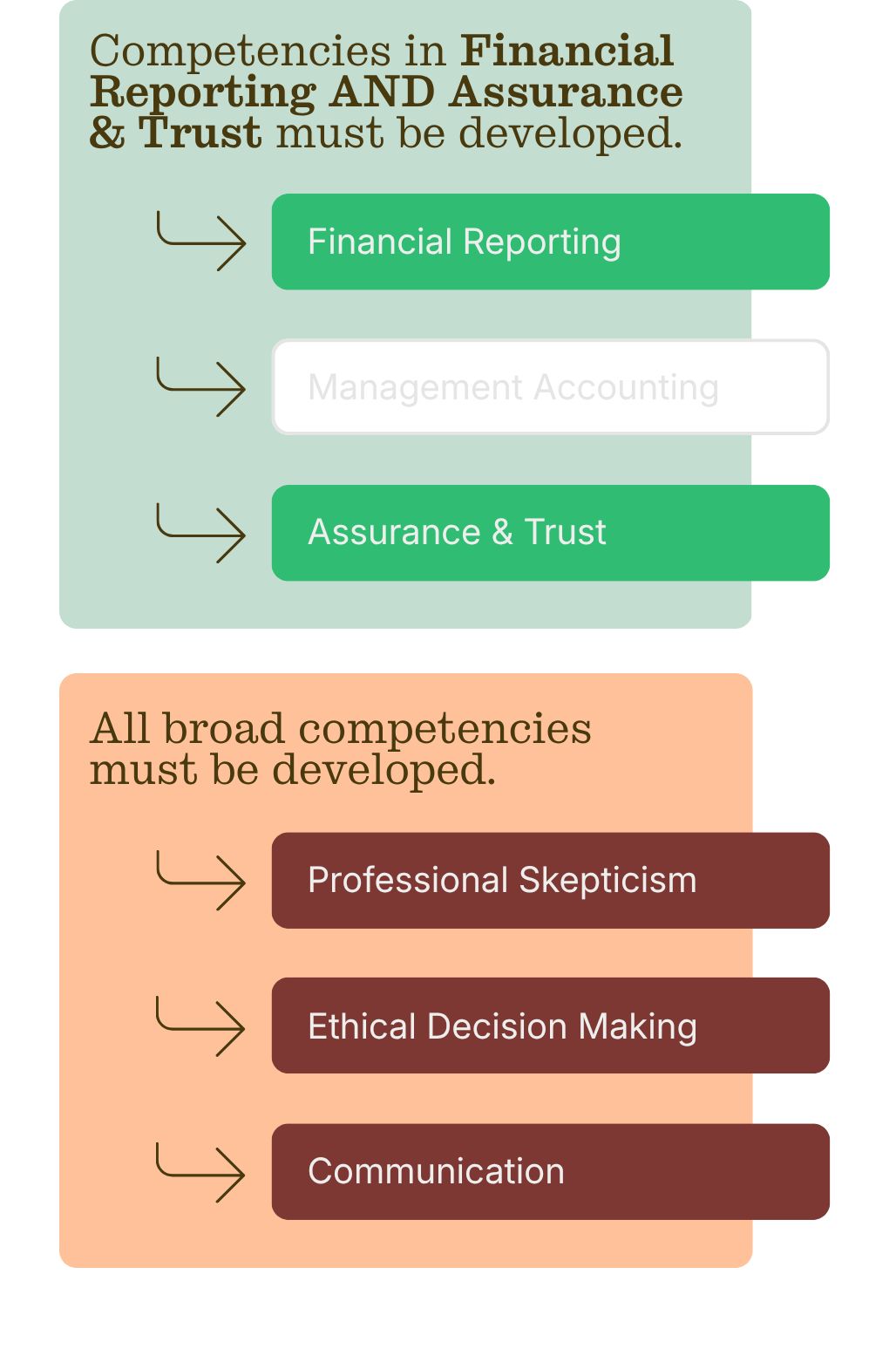
For detailed requirements for each competency category and the tasks to complete, see the practical experience competency assessment grid.
Practical experience competency assessment grid
| FINANCIAL REPORTING |
At the completion of your practical experience, you must have completed any two of the following four task statements and have demonstrated proficiency in using the optimal technology available in performing this work: TS1 : Assess(4) decision makers’ needs and actively design(5) the development or modification of reporting requirements or financial-reporting systems to meet external user needs, such as an MD&A or financing needs (a large, complex example or several smaller ones). TS2 : Critically evaluate(5) and reach a preliminary conclusion on three distinct GAAP (or equivalent) transactions based on management requests, using the CPA Canada Handbook (or equivalent) as guidance. TS3 : Prepare(2) and critically evaluate(5) financial statements and notes in accordance with GAAP or equivalent over two business periods (at least one of which is year-end). TS4 : Critically evaluate(5) variances on historical, year-over-year financial statements and interpret(5) root causes, including the interconnectivity of multiple line items (over two business periods, at least one of which is year-end). |
|
| MANAGEMENT ACCOUNTING |
At the completion of your practical experience, you must have completed any two of the following four task statements and have demonstrated proficiency in using the optimal technology available in performing this work: TS1 : Assess(4) decision makers’ needs and critically evaluate(5) the development or modification of information data systems required to meet management-reporting needs (a large, complex project, or several smaller ones). TS2 : Design(5) forecasts or a budget for an entity with multiple and changing input variables across more than two business cycles. TS3 : Critically evaluate(5) cost management or revenue management or profitability management for a minimum of two business quarters (proficiency level 5). TS4 : Interpret(5) variance analyses, either with key performance indicators or budget forecasts, with explanations and/or recommendations (over two business periods, at least one of which needs to be year-end). |
|
| ASSURANCE & TRUST |
At the completion of your practical experience leading to a public accountancy permit, you must have completed the following task statement and have demonstrated proficiency in using the optimal technology available in performing this work: TS1 : Through multiple external assurance engagements including high-risk or complex sections of the file: TS1.1 : Design(5) the planning and risk assessment of the assurance engagement (including calculating materiality and assessing the control environment). TS1.2 : Design(5) appropriate planned procedures that meet the objective of the engagement. TS1.3 : Critically evaluate(5) supporting information and results of analysis to draw conclusions and communicate results. |
|
| PROFESSIONAL SKEPTICISM |
At the completion of your practical experience, you must have completed all of the following: TS1 : Critically evaluate(5) actions and decisions by consistently demonstrating:
|
|
| ETHICAL DECISION MAKING |
At the completion of your practical experience, you must have completed all of the following: TS1 : Critically evaluate(5) a decision by consistently demonstrating:
|
|
| COMMUNICATION |
At the completion of your practical experience, you must have completed all of the following: TS1 : Demonstrate ability to consistently: TS1.1 : Communicate(4) analyses, findings, decisions, and next steps in a transparent, understandable, and professional manner with appropriate communication channels/tools TS1.2 : Assesses(4) that all communications fairly reflect underlying substance without bias. |
|

Questions?
Please feel free to contact us at stages@cpaquebec.ca to discuss your situation with our team. We will be happy to guide you.