CPA competencies assessed during the practical experience
New Professional Program

Are you on the right page?
This page provides information on the practical experience competencies for candidates enrolled in the new CPA Professional Program, which will be offered from 2027.
If you’re registered in the current CPA Professional Education Program or plan to register between now and December 2026, refer to the practical experience competencies page for that program.
A competency refers to your ability to apply your knowledge, judgment, and skills in a real-world professional setting.
CPA practical experience lets you gradually develop the competencies expected of future CPAs so that you can analyze situations of increasing complexity and effectively communicate your findings and recommendations.

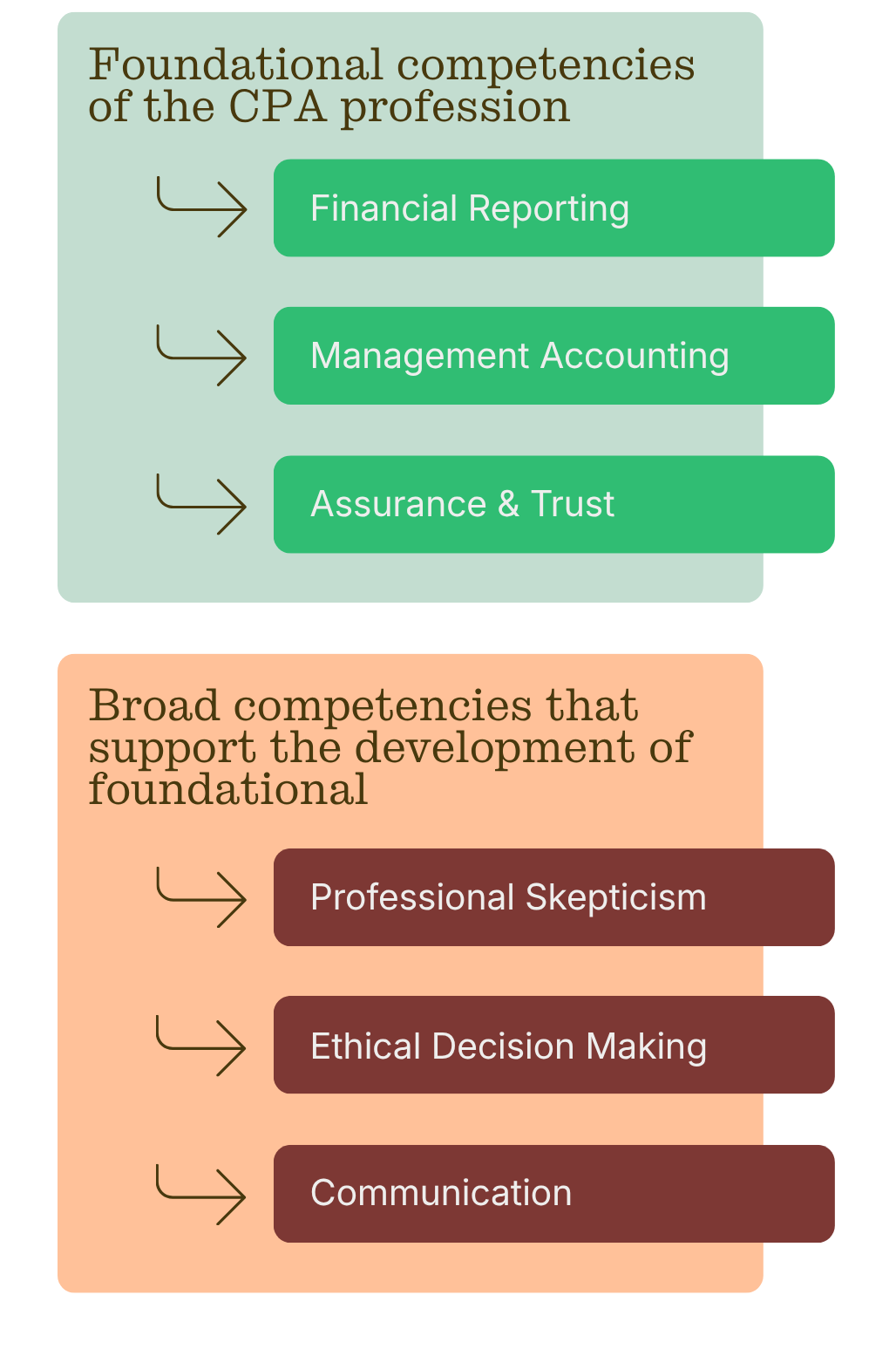
During your practical experience, you may develop CPA competencies across eight training areas. Learn more >
How are CPA competencies assessed?
The development of your competencies will be assessed at two key points: at the beginning of your practical experience in your work plan and in your practical experience report.
6 competency categories
The CPA competencies that you’ll develop during your practical experience are organized into six categories.
Each category includes a certain number of tasks that define how competencies should be demonstrated in practice in your work.
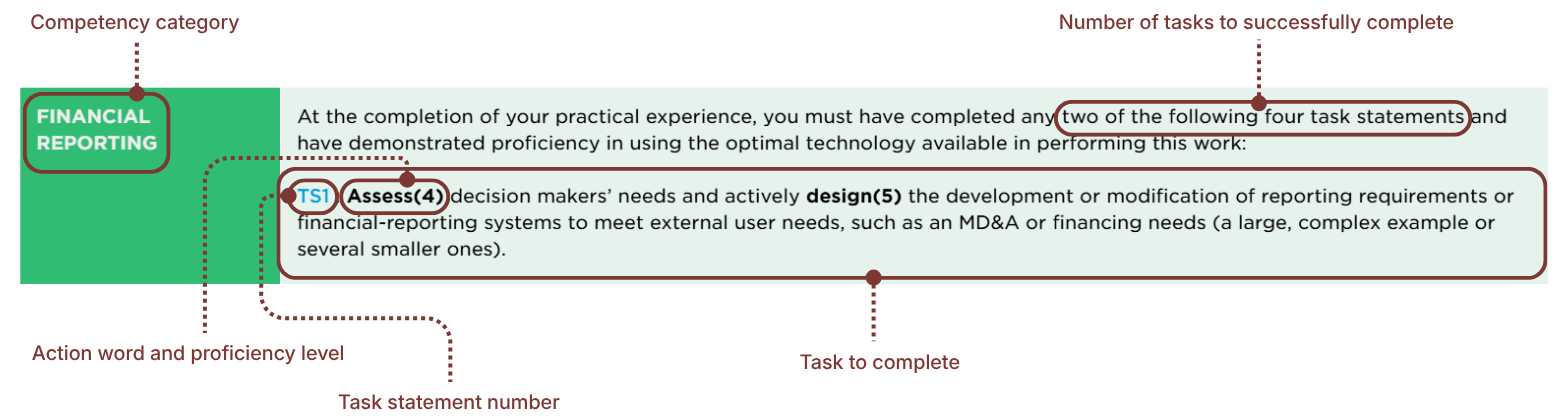
To conclude that you’ve developed the competencies in a category, the Order will verify that you’ve completed the required number of tasks for that category. For example, for the Financial Reporting category, you must complete at least two of the four listed tasks for that competency to be considered sufficiently developed.
Note that the categories of competencies to develop differ depending on the designation you wish to obtain (CPA designation or CPA auditor designation).
5 levels of proficiency
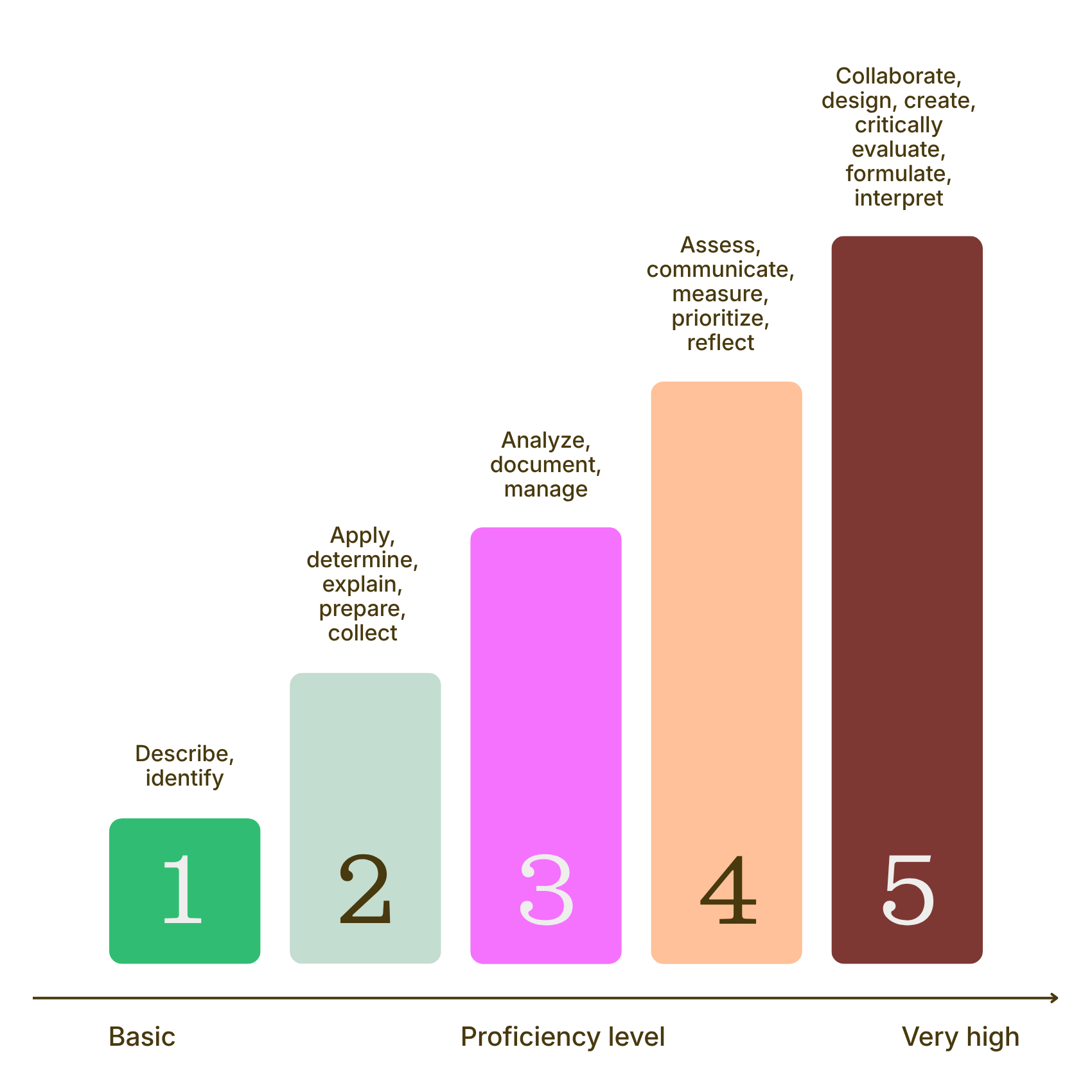
Each task statement (TS) is associated with a level of proficiency on a scale of one to five for the competency in question. The action word used in each statement reflects the proficiency level and clearly establishes the expected level for each task. The more complex the action, the higher the expected proficiency level.
Your proficiency level itself is not assessed, but rather your ability to successfully complete the task outlined in the statemen.
Example
Here’s an example to help explain how the practical experience competency assessment grid below is designed:
Recognition and requirements of practical experience
When analyzing your work plan, the Order will determine whether your practical experience constitutes foundational work experience or professional work experience.
The type of work experience is determined based on:
- when it was acquired,
- the responsibilities associated with your role,
- the level of complexity of the situations you plan to encounter,
- the competencies you will be expected to develop.
Foundational work experience
A maximum of 8 months of practical experience may be recognized by the Order as foundational work experience (for practical experience completed before or after registering with the Order) if it has allowed, or will allow you to carry out all the following tasks:
TS1: Prepare(2) or explain(2) information for input into internal or external reporting (e.g. financial statements, financial forecasts, financial budgets, management reports).
TS2: Identify(1) the user's needs and prepare(2) practical alternatives or variance analyses that consider the impact on user's needs.
TS3: Explain(2) your analyses and findings in a transparent, understandable and professional manner.
Professional work experience
A minimum of 16 months of practical experience may be recognized by the Order as professional work experience (only for practical experience completed after registering with the Order). At the completion of your practical experience, the Order’s analysis of your practical experience report will confirm whether you’ve properly developed the competencies needed to join the profession.
The competencies in which you must become proficient at the completion of your practical experience will differ depending on whether you wish to obtain a public accountancy permit (CPA auditor designation).
Practical experience leading to CPA designation
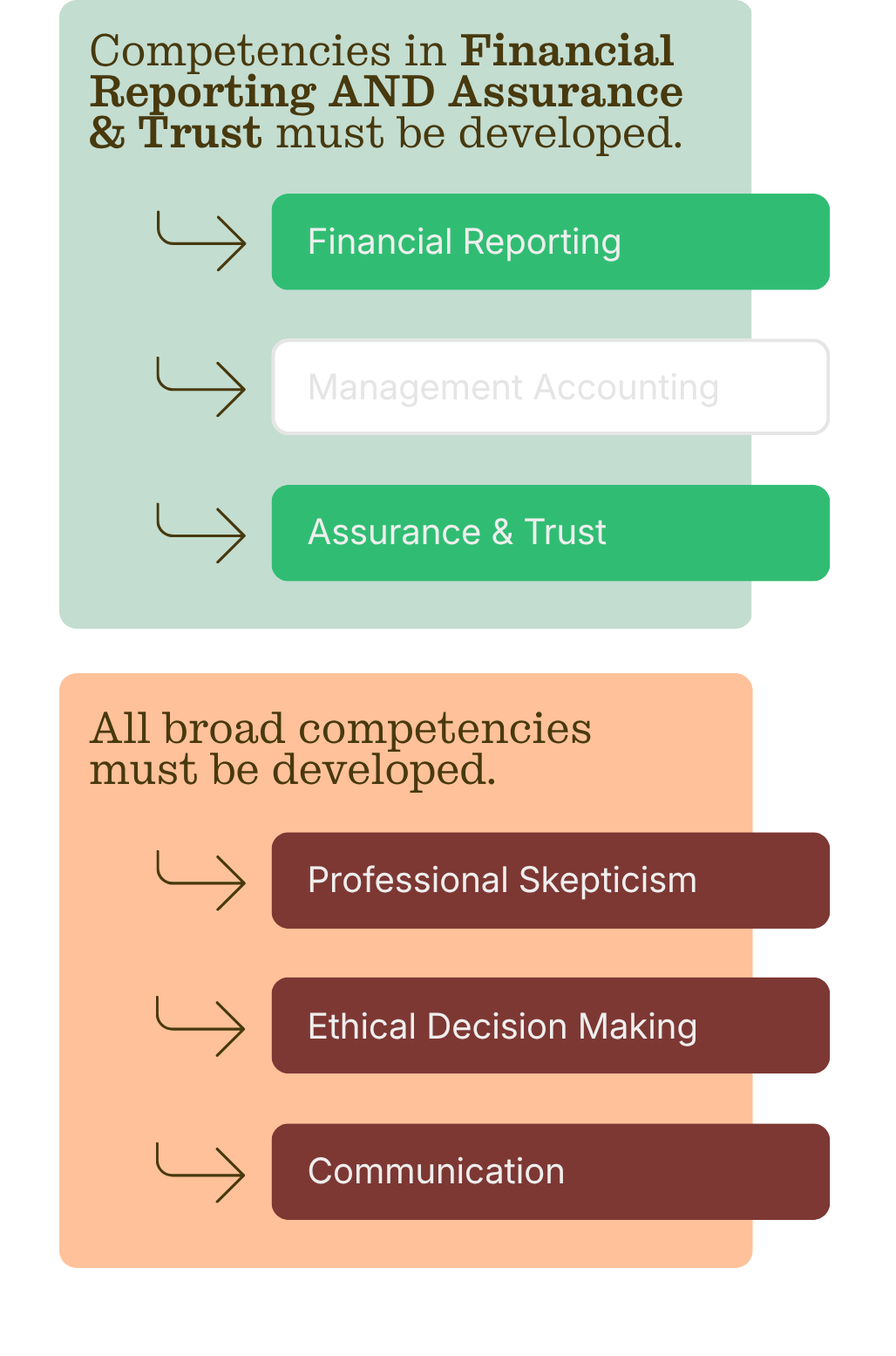
If you wish to obtain the CPA designation, you must demonstrate your competencies in the following categories:
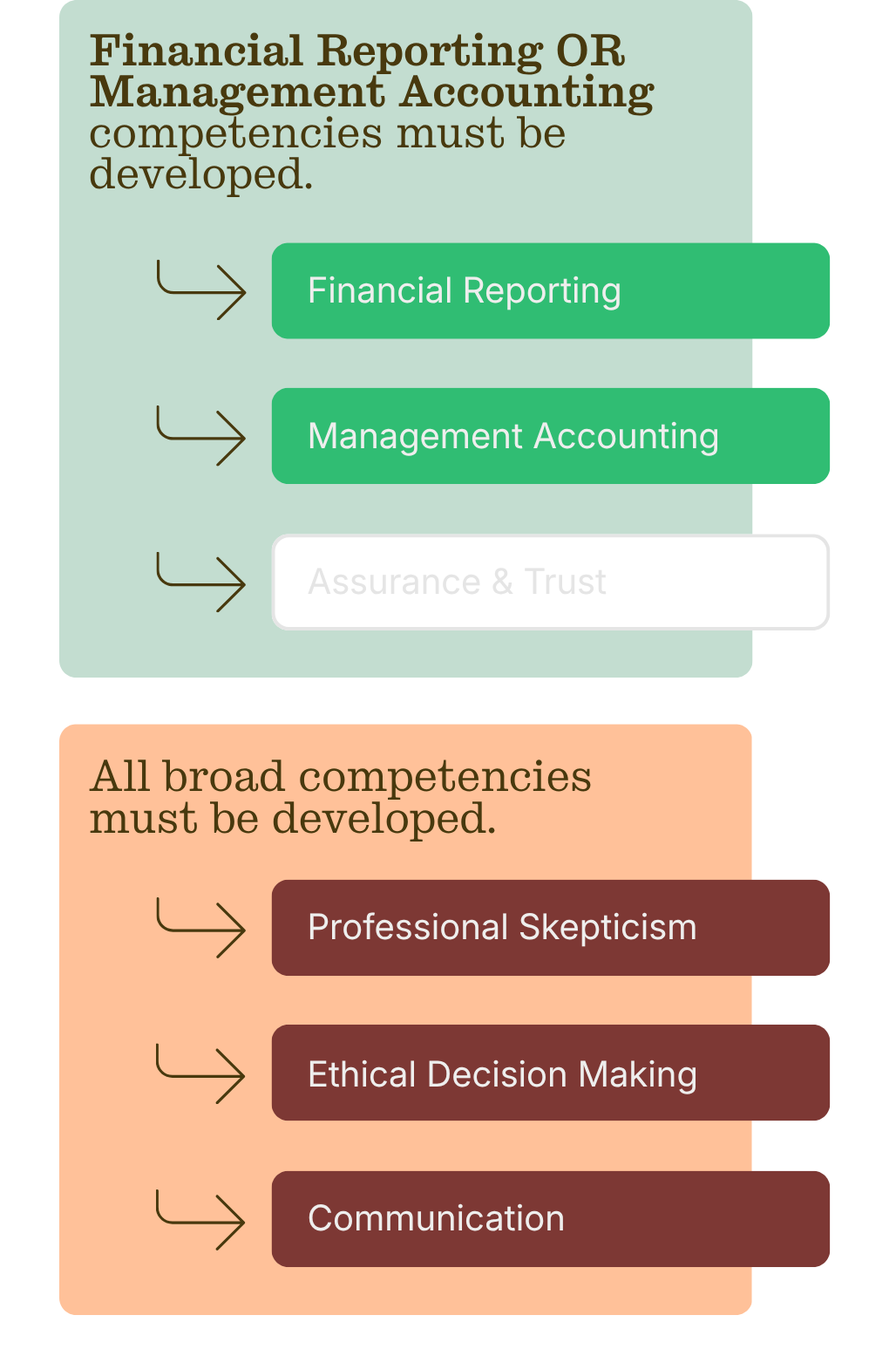
Depending on the nature of your role, you may develop competencies in both Financial Reporting AND Management Accounting. However, at a minimum, you must meet the requirements of one of these two categories, in addition to the broad competency requirements, for the Order to consider your practical experience a success.
For detailed requirements for each competency category and the tasks to complete, see the practical experience competency assessment grid.
Practical experience leading to the CPA auditor designation
If you wish to obtain a public accountancy permit, you must demonstrate your competencies in the following categories:
For detailed requirements for each competency category and the tasks to complete, see the practical experience competency assessment grid.
FINANCIAL REPORTING
To meet the Financial Reporting competency, you must successfully complete two of the four task statements (TS1 to TS4). A task statement is considered successfully completed only when you can answer “Yes” to all the questions associated with that statement.
TS1: Assess(4) decision makers’ needs and actively design(5) the development or modification of reporting requirements or financial-reporting systems to meet external user needs, such as an MD&A or financing needs (a large, complex example or several smaller ones).
Questions associated with this task statement
- Did you have to assess external users’ information needs (e.g., lenders requiring covenants, investors requiring MD&A clarity)? Yes or no
- Did you have to critically evaluate areas where financial reporting processes could be improved for accuracy or compliance (e.g., manual schedules, unclear disclosures, inefficiencies)? Yes or no
- Did you have to design or modify reporting requirements or financial-reporting systems that address external user needs? Yes or no
Examples of tasks that meet the success criteria for this task statement
- Assess external users’ information needs (e.g., lenders, investors, regulatory bodies, or other stakeholders), then critically evaluate financial reporting processes, reports, or systems for clarity, accessibility, compliance, and usefulness and design or modify reporting requirements, reports, or processes to better address user needs.
- Analyze financial and operational data from multiple systems to assess user needs and critically evaluate the information used in decision making for relevance, reliability, consistency, and traceability.
- Participate in designing or modifying financial reporting processes, reports, or systems to improve the quality, integrity, or use of financial and non-financial information.
- Assess information needs related to environmental, social, and governance (ESG) factors or other non-financial information, critically evaluate the processes for collecting and disclosing this information, and recommend or design improvements.
- Critically evaluate processes for collecting, validating, integrating, or governing financial and non-financial data, including data from multiple sources or large volumes of data, and design or recommend improvements to reporting systems or processes.
- Inform upper management or executives about user needs, any gaps identified, and any recommended improvements for financial or non-financial reporting.
Examples of tasks that do not meet the success criteria for this task statement
- Produce financial reports without assessing the needs of their intended users.
- Compile, validate, or transfer data without critically evaluating its relevance, quality, or usefulness.
- Apply changes to reports, processes, or systems in accordance with established guidelines without participating in designing or modifying them or assessing underlying needs.
- Produce or update ESG, financial, or MD&A reports without analyzing whether the information meets user needs.
- Perform only technical, administrative, or maintenance tasks related to financial reporting systems.
- Use analytical, automated, or artificial intelligence tools solely to generate information without critically evaluating its relevance or reliability.
TS2: Critically evaluate(5) and reach a preliminary conclusion on three distinct GAAP (or equivalent) transactions based on management requests, using the CPA Canada Handbook (or equivalent) as guidance.
Questions associated with this task statement
- Did you have to evaluate and formulate well-supported preliminary conclusions on non-routine and/or complex transactions using the CPA Canada Handbook (or equivalent) as guidance? Examples could include: equity accounting, impairment, purchase accounting, development cost and wind-ups, financial instruments, complex tax provisions, etc. Yes or no
- Through the work above, did you have to demonstrate in-depth understanding of THREE distinct GAAP (or equivalent) guidance? Yes or no
Examples of tasks that meet the success criteria for this task statement
- Critically evaluate non-routine and/or complex transactions requiring interpretation of the applicable financial reporting framework and formulate well-supported preliminary conclusions regarding the appropriate accounting treatment.
- Conduct analyses and research using the CPA Canada Handbook (or equivalent) as guidance to critically evaluate the appropriate accounting treatment for a specific transaction or situation.
- Critically evaluate three distinct transactions involving different areas of GAAP (or equivalent) guidance, such as impairment, financial instruments, business combinations, revenue, leases, development cost and wind-ups, or complex tax provisions.
- Assess the appropriateness of the accounting treatment applied to a non-routine and/or complex transaction, evaluate possible solutions, and exercise professional judgment in determining the necessary adjustments.
- Critically evaluate how new standards, changes to standards, or specific circumstances may affect accounting treatment, required adjustments, and financial reporting.
- Review and evaluate non-routine and/or complex accounting entries, such as those related to the equity method, joint arrangements, impairment, business combinations, capitalization of development costs, financial instruments, uncertain tax positions, wind-ups, restructurings, or discontinued operations.
- Formulate well-supported preliminary conclusions on appropriate accounting treatments, documenting the analysis performed, standards or guidelines consulted, judgments made, and adjustments recommended.
- Critically evaluate the implementation of a new accounting standard or a change to the applicable framework, including an analysis of possible solutions, the expected impact on financial statements, and the adjustments needed to ensure compliance with GAAP (or equivalent) guidance.
- Inform those responsible for preparing or reviewing financial reporting about preliminary conclusions, judgments made, and recommendations for the accounting treatment of non-routine and/or complex transactions.
Examples of tasks that do not meet the success criteria for this task statement
- Process routine or recurring entries without critically evaluating the applicable accounting treatment or exercising professional judgment.
- Prepare or record accounting entries according to specific instructions without analyzing, interpreting, or formulating conclusions about the appropriate accounting treatment.
- Update existing memos or documentation without conducting additional research or formulating well-supported preliminary conclusions.
- Compare balances, entries, or data with those from prior periods without evaluating the variances using the applicable financial reporting framework.
- Apply established accounting treatments or existing procedures without having to interpret the requirements of the CPA Canada Handbook or equivalent guidance.
- Document conclusions formulated by others without critically evaluating the underlying analysis or exercising professional judgment.
- Address only one area of the financial reporting framework, as part of routine activities, without demonstrating an in-depth understanding of three distinct GAAP (or equivalent) standards or guidelines.
- Perform only perfunctory validations, calculations, or reconciliations, even if related to material transactions, without assessing whether the accounting treatment is appropriate or whether adjustments are needed.
- Use technological tools, models, templates, or automatically generated results without critically evaluating whether the proposed treatment complies with the applicable framework.
TS3: Prepare(2) and critically evaluate(5) financial statements and notes in accordance with GAAP or equivalent over two business periods (at least one of which is year-end).
Questions associated with this task statement
- Did you have to critically evaluate at least one major financial statement area in accordance with GAAP (Balance Sheet, Income Statement, Statement of Cash Flows, Statement of Changes in Equity, or Notes) for a complex company or the majority of the financial statement and applicable notes for a smaller company? Yes or no
- Did you have to participate in two business periods, including at least one year-end cycle? Yes or no
- Did you have to critically evaluate financial information for accuracy and completeness, including identifying possible GAAP-related adjustments considering presentation and disclosure requirements? Yes or no
Examples of tasks that meet the success criteria for this task statement
- Critically evaluate at least one major financial statement area in accordance with GAAP (or equivalent) guidance for a complex company or the majority of the financial statements and applicable notes for a smaller company, checking for accuracy, completeness, and compliance.
- Critically evaluate several interrelated financial statement items, such as debt, interest expense, shareholders’ equity, cash flows, and notes, for presentation and disclosure.
- Identify classification errors, missing information, inconsistencies between the financial statements and their notes, or possible GAAP-related adjustments, then assess their impact on the fair presentation of the financial information.
- Critically evaluate significant balances, accounting estimates, or financial information involving a level of judgment or significant uncertainty, considering presentation and disclosure requirements.
- Compare financial information for two business periods, including at least one year-end cycle, to critically evaluate its consistency, accuracy, and completeness.
- Analyze how a proposed transaction, event, or adjustment may affect multiple financial statements and their notes, then determine the changes required to ensure compliant, fair presentation.
- Critically evaluate financial statements and notes prepared for an audit, review, or other form of assurance engagement, particularly considering presentation, classification, and disclosure requirements.
- Collaborate with management, those charged with governance, auditors, or other stakeholders to resolve issues related to the presentation, disclosure, or adjustments required in the financial statements.
- Use technological tools, financial systems, dashboards, or data analyses to support the review of financial statements, critically evaluating the information produced for relevance, accuracy, and completeness.
- Formulate recommendations aimed at improving the quality, transparency, compliance, or usefulness of the financial information presented in financial statements and notes.
Examples of tasks that do not meet the success criteria for this task statement
- Perform an administrative reconciliation of financial statements without critically evaluating the financial information for presentation, accuracy, completeness, or compliance.
- Generate financial statements as direct output from information systems without analyzing the results produced or identifying possible GAAP-related adjustments.
- Update financial statements or notes by reproducing information from the prior year without evaluating it for relevance, completeness, and compliance.
- Prepare only master spreadsheets, supporting schedules, or working papers that do not affect the final presentation of financial statements.
- Compile, transfer, or format financial data without critically evaluating its classification, accuracy, or impact on financial reporting.
- Perform only data entry, perfunctory validation, or formatting tasks related to financial statements without analyzing the underlying financial content.
- Review only the spelling, visual presentation, or format of financial statements and notes without considering presentation and disclosure requirements.
- Participate in one business period or limited interim work only, not covering two business periods, including at least one year-end cycle.
- Use automated tools, templates, or system-generated reports without critically evaluating whether the information produced is accurate, complete, compliant, and properly presented.
TS4: Assess(4) variances on historical, year-over-year financial statements and interpret(5) root causes, including the interconnectivity of multiple line items (over two business periods, at least one of which is year-end).
Questions associated with this task statement
- Did you have to interpret variance analyses on financial results, including identifying significant fluctuations involving at least two reporting periods, including at least one year-end financial statement cycle? Yes or no
- Did you have to critically evaluate and explain root causes of variances using supporting schedules to communicate variance insights supporting strategic decision making? Yes or no
- Did you have to critically evaluate interconnectivity of multiple line items (how movements in one financial statement line item affect others)? Yes or no
Examples of tasks that meet the success criteria for this task statement
- Interpret variance analyses on financial results across at least two reporting periods, including at least one year-end cycle, and identify significant fluctuations requiring further analysis.
- Critically evaluate observed variances and explain their root causes using supporting schedules, trend analyses, ratios, data visualizations, or other analytical tools.
- Critically evaluate several possible explanations for a fluctuation and use professional judgment to identify the most significant factors.
- Explain how multiple financial statement line items are interconnected and demonstrate how movements in one line item affect others (e.g., revenue → accounts receivable → cash flow; inventory → cost of goods sold → margins).
- Link financial results to their underlying operational, strategic, economic, or industry factors to explain observed variances.
- Distinguish between normal fluctuations related to day-to-day operations and unusual trends, anomalies, or risk indicators requiring particular attention.
- Interpret results generated by analytical tools, dashboards, predictive models, or data analyses and critically evaluate them for consistency with the organization’s operational reality.
- Analyze financial results over multiple periods to identify long-term trends, significant changes in performance, or the impact of specific events.
- Communicate the root causes of variances, their impact on financial performance, and key risks or opportunities to support strategic decision making.
- Formulate findings, conclusions, or recommendations based on an analysis of variances and their impact on the organization’s financial results.
Examples of tasks that do not meet the success criteria for this task statement
- Calculate or present variances without interpreting the results or explaining their root causes.
- Document explanations provided by other teams or departments without critically evaluating their validity or reasonableness.
- Identify fluctuations in financial results without investigating their underlying causes.
- Produce spreadsheets, charts, reports, or visualizations without analyzing the results or drawing conclusions from them.
- Interpret a single financial statement line item without demonstrating how it connects to others.
- Present ratios, indicators, or trends without explaining how they may affect financial performance or decision making.
- Use analytical tools, dashboards, automated solutions, or artificial intelligence tools solely to generate analyses without critically evaluating the results.
- Describe changes from one period to the next without tying them to the organization’s activities, operations, or economic context.
- Perform only calculations, reconciliations, or perfunctory analytical procedures without exercising professional judgment.
MANAGEMENT ACCOUNTING
To meet the Management Accounting competency, you must successfully complete two of the four task statements (TS1 to TS4). A task statement is considered successfully completed only when you can answer “Yes” to all the questions associated with that statement.
TS1: Assess(4) decision makers’ needs and critically evaluate(5) the development or modification of information data systems required to meet management-reporting needs (a large, complex project, or several smaller ones).
Questions associated with this task statement
- Did you have to collaborate with key decision makers to understand management-reporting needs and the context in which information is used? Yes or no
- Did you have to critically evaluate the existing data systems to identify how well they support management-reporting needs? Yes or no
- Did you have to design and create modifications or provide recommendations for enhancements to information data systems that align with managements-reporting needs, within the scope of a large, complex project or several smaller ones? Yes or no
Examples of tasks that meet the success criteria for this task statement
- Collaborate with key decision makers to understand management reporting needs, strategic objectives, performance drivers, and the context in which information is used for decision making.
- Critically evaluate existing data systems, reports, dashboards, or indicators to identify how well they support management reporting needs in terms of information relevance, timeliness, integrity, and reliability.
- Critically evaluate the gaps, limitations, or risks associated with existing data systems, particularly when information comes from multiple sources, separate systems, or conflicting data.
- Design and create modifications or provide recommendations for enhancements to information data systems, MD&A reports, dashboards, or reporting processes to better meet management needs.
- Create or improve key performance indicators (KPIs), financial or non-financial measures, or dashboards that require integrating data from various financial and operational sources.
- Critically evaluate the quality, consistency, traceability, and usefulness of the data used to support decision making and recommend necessary enhancements.
- Review and improve forecast models, cost-tracking tools, profitability analytical models, or automated performance- and variance-monitoring mechanisms.
- Assess reporting needs related to ESG indicators, operational measures, or other non-financial information and then design, create, or recommend improvements to the systems or processes used to generate this information.
- Use data analysis tools and automation, visualization, or artificial intelligence solutions to support reporting needs analyses and system improvements, critically evaluating the results for relevance and reliability.
- Critically evaluate the trade-offs between accuracy, distribution timeliness, information accessibility, system capabilities, and user needs when designing a management information system.
Examples of tasks that do not meet the success criteria for this task statement
- Update existing reports, files, or dashboards without collaborating with decision makers or critically evaluating whether those systems remain useful or effective.
- Produce recurring periodic reports without participating in assessing management reporting needs or in enhancing the underlying systems.
- Update performance indicators or measures based on criteria defined by others without participating in designing or evaluating them.
- Make only cosmetic or formatting changes to dashboards, reports, or information systems.
- Compile, extract, or transfer data without critically evaluating it for quality, consistency, or relevance to decision making.
- Perform only technical activities related to a system’s maintenance or operation without contributing to the enhancement of reporting needs or decision-making processes.
- Use technological tools, analytical platforms, or artificial intelligence solutions solely to generate reports or indicators without critically evaluating them for relevance or usefulness to decision makers.
- Create modifications to a system or report, as instructed by others, without participating in analyzing needs or recommending enhancements.
TS2: Create(5) forecasts or a budget for an entity with multiple and changing input variables across more than two business cycles.
Questions associated with this task statement
- Did you have to collaborate with relevant stakeholders to evaluate assumptions, constraints, and key drivers affecting the forecast or budget across more than two business cycles? Yes or no
- Did you have to create and design a forecast or budget that incorporates multiple changing input variables (e.g., pricing, volume, exchange rates, costs)? Yes or no
- Did you have to design sensitivity or scenario analyses to assess how changes in underlying assumptions may affect forecast or budget outcomes? Yes or no
Examples of tasks that meet the success criteria for this task statement
- Collaborate with relevant stakeholders to evaluate assumptions, constraints, and key drivers affecting the forecast or budget, such as volume, pricing, costs, exchange rates, market conditions, or business drivers.
- Create and design a forecast or budget that incorporates multiple changing and interdependent input variables across more than two business cycles.
- Critically evaluate the assumptions underlying forecasts or budgets for relevance, consistency, and reasonableness and identify any inappropriate, inconsistent, or unrealistic input data.
- Design sensitivity or scenario analyses to assess how changes in assumptions, economic conditions, business strategies, or business drivers may affect expected outcomes.
- Create or improve forecasting or budgeting models that incorporate financial and operational variables from multiple data sources.
- Assess how various assumptions or scenarios may affect expected outcomes and communicate the associated risks, opportunities, or challenges to decision makers.
- Design forecasting or budgeting models that incorporate changing demand, operational capacity, cost structure, pricing, or other variables that may affect future outcomes.
- Collaborate with multiple departments within the organization to incorporate their inputs and reconcile differing assumptions when designing a forecast or budget.
- Use data analysis tools, predictive models, dashboards, automation techniques, or artificial intelligence to support the design of forecasts, critically evaluating the results for relevance and reasonableness.
- Create or improve models that integrate financial, operational, or ESG indicators or other relevant non-financial measures into planning and decision making.
Examples of tasks that do not meet the success criteria for this task statement
- Update a forecast or budget using data provided by others without evaluating its reasonableness or underlying assumptions.
- Prepare an estimate covering only one period or based on a limited number of variables, without taking into account different business cycles.
- Compile or consolidate budget data without participating in evaluating assumptions or designing the forecasting model.
- Perform only administrative tasks related to budget data collection, validation, or entry.
- Update existing models without creating, designing, or significantly improving the assumptions, variables, or methodology used.
- Documenter les conclusions formulées par d’autres personnes sans évaluer de manière critique l’analyse sous-jacente ni exercer de jugement professionnel.
- Produce a static forecast or budget without conducting a sensitivity or scenario analysis or an assessment of assumption-related risks.
- Use analytical tools, automated models, or artificial intelligence solutions solely to generate forecasts without evaluating them for relevance or reasonableness.
- Follow an established methodology or model without participating in evaluating the assumptions, designing the model, or analyzing the results.
TS3: Critically evaluate(5) cost management or revenue management or profitability management for a minimum of two business quarters (proficiency level 5).
Questions associated with this task statement
- Did you have to create and design costing and pricing methodologies to inform complex management decisions (e.g., make-or-buy, sourcing, pricing alternatives)? Yes or no
- Did you have to interpret and evaluate key drivers of financial performance, such as volume, pricing, and resource utilization? Yes or no
- Did you have to critically evaluate the financial and strategic impacts of cost and revenue decisions using both quantitative and qualitative methods (such as sensitivity and breakeven scenarios) over at least two business quarters? Yes or no
- Did you have to formulate strategies to enhance efficiency or performance, including improved cost tracking, process improvements, or optimization of revenue streams? Yes or no
Examples of tasks that meet the success criteria for this task statement
- Create and design costing, pricing, and profitability analysis methodologies to inform complex management decisions, e.g., make-or-buy, sourcing, pricing, product launches, or resource allocation.
- Interpret and evaluate key drivers of financial performance, such as volume, pricing, margins, operational capacity, productivity, or resource utilization, over at least two business quarters.
- Critically evaluate the financial and strategic impacts of decisions related to costs, prices, products, customers, or distribution channels using both quantitative and qualitative methods.
- Design sensitivity or breakeven analyses or scenarios to assess the impact of changing assumptions about costs, prices, volumes, or market conditions.
- Analyze different types of costs, such as fixed, variable, direct, indirect, or discretionary costs, to support decision making and improve performance.
- Create or improve costing models, such as cost by activity, by product, by contract, by project, or by customer, to support management decisions.
- Assess the profitability of products, services, customer segments, distribution channels, or strategic initiatives to identify opportunities to enhance performance.
- Interpret the results of cost, margin, or profitability analyses and develop strategies to optimize revenue streams, reduce costs, improve processes, or enhance resource utilization.
- Critically evaluate the financial and operational implications of various pricing strategies, including their impacts on demand, competition, margins, and the organization’s overall results.
- Use analytical models, data analysis tools, dashboards, automation techniques, or artificial intelligence to support cost, pricing, or profitability analyses, critically evaluating the results for relevance and reasonableness.
- Conduct analyses incorporating financial, operational, ESG, and other qualitative factors that may influence management decisions and the organization’s long-term performance.
- Formulate strategic recommendations to improve the organization’s financial performance, business model, cost structure, or revenue streams, using the analysis results.
Examples of tasks that do not meet the success criteria for this task statement
- Perform perfunctory cost allocations or calculations without evaluating the methods used or their impacts on management decisions.
- Collect, compile, or update data on costs, prices, or margins without interpreting it or analyzing its implications.
- Produce periodic reports on costs, margins, or profitability without evaluating the factors that influence the results or formulating recommendations.
- Apply existing costing or pricing methodologies without participating in their design, improvement, or evaluation.
- Conduct analyses for only one quarter or period without demonstrating an evaluation of trends or impacts over multiple periods.
- Perform break-even, margin, or profitability calculations without analyzing the results or their impacts on management decisions.
- Use analytical tools, automated models, or artificial intelligence solutions solely to produce calculations or reports without critically evaluating the results.
- Describe cost or performance variances without analyzing their causes, consequences, or opportunities for improvement.
- Formulate recommendations based solely on financial calculations without taking into account relevant operational, strategic, or qualitative factors.
TS4: Interpret(5) variance analyses, either with key performance indicators or budget forecasts, with explanations and/or recommendations (over two business periods, at least one of which needs to be year-end).
Questions associated with this task statement
- Did you have to interpret complex variance results and evaluate their implications for financial performance and operational effectiveness over two business periods, at least one of which needs to be year end? Yes or no
- Did you have to formulate meaningful explanations for variances and develop actionable recommendations to address key issues? Yes or no
- Did you have to critically evaluate quantitative results (e.g., KPI trends, budget variances) alongside qualitative insights to support strategic decision making? Yes or no
- Did you have to assess how key internal or external factors contributed to variances and evaluate their impact on future performance? Yes or no
Examples of tasks that meet the success criteria for this task statement
- Interpret complex variance results over at least two business periods, including at least one year-end cycle, integrating variances from the budget, forecasts, targets, or key performance indicators (KPIs).
- Assess the impact of observed variances on financial performance, operational efficiency, profitability, resource utilization, or the achievement of strategic objectives.
- Determine the root causes of variances by analyzing the financial, operational, commercial, organizational, or external factors that contributed to the observed results.
- Critically evaluate how different performance factors, such as volumes, prices, costs, productivity, capacity, available resources, and market conditions, are interrelated.
- Interpret trends in KPIs, margins, costs, revenue, or other performance measures to assess their impact on the organization’s future performance.
- Critically evaluate quantitative results alongside qualitative insights, including operational, strategic, regulatory, and ESG changes, as well as market conditions, to support decision making.
- Present variance analyses to management, highlighting root causes, risks, opportunities, and potential impacts on future results.
- Develop actionable recommendations aimed at improving financial or operational performance, including through process optimization, expenditure control, price adjustments, productivity improvements, or enhancements to revenue strategies.
- Determine to what extent observed variances should lead to changes in forecasts, budgets, operational strategies, or performance objectives.
- Use data analysis tools, dashboards, predictive models, automation techniques, or artificial intelligence to support the analysis of variances and trends, critically evaluating the results for relevance and reasonableness.
- Evaluate the future impact of internal or external factors such as price fluctuations, volume changes, capacity constraints, inflationary pressure, supply chain disruptions, or changing market conditions.
Examples of tasks that do not meet the success criteria for this task statement
- Prepare variance or performance reports that only present figures without explaining their causes or implications.
- Describe variances between the budget and actual results without interpreting the factors that contributed to them.
- Update KPIs, dashboards, or MD&A reports without analyzing trends or drawing conclusions.
- Repeat explanations provided by others without critically evaluating their validity or reasonableness.
- Focus on a single reporting period without evaluating trends or changes in performance across multiple periods.
- Perform only perfunctory calculations or analyses without tying the results to the organization’s operations, processes, or objectives.
- Use analytical models, dashboards, or automated tools solely to generate reports without interpreting the results or formulating recommendations.
- List observed variances without identifying their root causes or impact on future performance.
- Present quantitative results without taking into account qualitative, operational, or strategic factors that may influence performance.
- Communicate financial or operational results without formulating recommendations or demonstrating how they support decision making.
ASSURANCE & TRUST
To meet the Assurance & Trust competency, you must successfully complete all the following task statements. A task statement is considered successfully completed only when you can answer “Yes” to all the questions associated with that statement.
TS1: Through multiple external assurance engagements including high-risk or complex sections of the file:
TS1.1: Formulate(5) the planning and risk assessment of the assurance engagement (including calculating materiality and assessing the control environment).
Questions associated with this task statement
- Did you have to formulate the assurance plan, including critically evaluating key financial statement areas and related risks (e.g., revenue recognition, inventory existence, estimates), to understand how planning decisions influence the assurance approach and scope? Yes or no
- Did you have to calculate materiality and critically evaluate performance materiality thresholds (e.g., based on revenue, assets, or net income benchmarks)? Yes or no
- Did you have to assess the control environment and areas where reliance on controls may be appropriate? Yes or no
Examples of tasks that meet the success criteria for this task statement
- Formulate an assurance plan, including critically evaluating key financial statement areas and related risks, particularly in complex or high-risk areas, such as revenue recognition, accounting estimates, inventory, business combinations, or financial instruments.
- Critically evaluate the risks of material misstatements and determine how they may affect the assurance strategy, including the use of a substantive or combined approach.
- Calculate overall materiality and performance materiality thresholds, then critically evaluate whether they are appropriate in light of the scope, nature, and specific risks of the engagement.
- Assess the client’s control environment, including relevant controls across multiple accounting cycles, and draw conclusions regarding areas where reliance on controls may be appropriate as part of the assurance strategy.
- Critically evaluate control deficiencies and determine how they may affect the engagement risk, planned procedures, or scope.
- Incorporate the requirements of applicable professional standards (e.g., CAS, International Standards on Auditing, or other assurance standards) into risk assessment, assurance strategy selection, and work planning.
- Use data analysis tools, visualizations, data mining techniques, or other technologies to support risk identification and assessment, critically evaluating the results for relevance and reliability.
- Participate in planning multiple assurance engagements involving different risk profiles, industries, or control environments, adapting the assurance strategy accordingly.
- Determine whether supporting information is sufficient and appropriate to support risk assessments and planning decisions, identifying any gaps, inconsistencies, or areas requiring further work.
Examples of tasks that do not meet the success criteria for this task statement
- Copy or carry over the previous year’s plan without critically evaluating changes in risk, the control environment, or the specific circumstances of the engagement.
- Fill out questionnaires, checklists, or planning forms without understanding their purpose or how they may affect the assurance strategy.
- Calculate materiality thresholds in a perfunctory manner, without evaluating whether they are appropriate or how they may affect the engagement.
- Document risks identified by other team members without participating in risk assessment or in determining the assurance strategy.
- Perform only planning-related administrative tasks (budgets, scheduling, file compilation, or deadline tracking).
- Carry out a pre-established work plan for relatively straightforward tasks without participating in risk assessment or engagement planning.
- Use data analysis tools or other automated tools solely to generate reports or indicators without critically evaluating the risks involved or how they may affect the assurance strategy.
- Describe the controls in place without evaluating their design, implementation, or reliability in the context of the engagement.
TS1.2: Design(5) appropriate planned procedures that meet the objective of the engagement.
Questions associated with this task statement
- Did you have to interpret materiality thresholds and consider sampling factors when designing the nature, timing, and extent of assurance procedures that align with identified risks and relevant assertions? Yes or no
- Did you have to collaborate with senior team members when formulating or designing assurance procedures to ensure procedures are appropriate for client circumstances? Yes or no
Examples of tasks that meet the success criteria for this task statement
- Interpret materiality thresholds, performance materiality thresholds, and sampling factors when designing assurance procedures for which the nature, timing, and extent align with identified risks.
- Collaborate with senior team members when designing assurance procedures that address the risks of material misstatements and relevant assertions (e.g., existence, completeness, evaluation, presentation, or rights and obligations).
- Design substantive procedures or combinations of control testing and substantive procedures appropriate for complex or high-risk areas.
- Adapt assurance procedures to the client’s specific situation, including industry, control environment, information systems, and any major changes in operations.
- Interpret the results of risk assessments, control evaluations, or analytical procedures in order to change or refine planned assurance procedures accordingly.
- Collaborate with senior team members to determine whether additional, different, or more extensive procedures are required in light of identified risks.
- Design assurance procedures involving data from multiple systems, large volumes of transactions, or data analysis techniques
- Use data analysis tools, technology-assisted sampling techniques, or automation tools to design procedures, critically evaluating their relevance in light of the risks and assertions.
- Determine whether planned procedures remain appropriate in light of changes in operations, systems, controls, or results obtained during the engagement, adjusting the work plan accordingly.
Examples of tasks that do not meet the success criteria for this task statement
- Carry out assurance procedures without participating in designing or adapting them.
- Copy or carry over the previous year’s work plans without interpreting risks, materiality thresholds, or engagement-specific circumstances.
- Propose procedures without relating them to the identified risks or relevant assertions.
- Apply methodologies, checklists, or work plans in a perfunctory manner, without exercising professional judgment regarding the nature, timing, or extent of the procedures.
- Determine sample sizes without taking into account risks, materiality thresholds, or procedure objectives.
- Perform only administrative tasks related to file preparation or procedure documentation
- Use data analysis tools, models, or automated tools solely to run predefined tests without participating in the design of the underlying procedures.
- Carry out a work plan prepared by other team members without contributing to its design, customization, or adaptation.
TS1.3: Critically evaluate(5) supporting information and results of analysis to draw conclusions and communicate results.
Questions associated with this task statement
- Did you have to critically evaluate whether supporting information obtained is sufficient and appropriate to support well-reasoned conclusion or communicate potential inconsistencies or gaps to senior team members? Yes or no
- Did you have to formulate and communicate conclusions (e.g., assurance memos, management letter points) that are clearly supported by assurance proof? Yes or no
Examples of tasks that meet the success criteria for this task statement
- Critically evaluate whether supporting information obtained is sufficient and appropriate to support an assurance conclusion, taking into account the quality, relevance, reliability, and consistency of the evidence gathered.
- Determine whether any conflicting, incomplete, or unexpected evidence calls preliminary conclusions into question and communicate potential inconsistencies or gaps to senior team members.
- Identify discrepancies in test results, analytical procedures, supporting documentation, external confirmations, or explanations provided by the client and critically evaluate how they may affect assurance conclusions..
- Demonstrate critical thinking by comparing results obtained with expectations established during planning and by determining whether additional work is needed before drawing a conclusion.
- Formulate conclusions that are clearly supported by sufficient and appropriate evidence regarding an assertion, identified risk, or important area of the engagement.
- Draft and communicate assurance notes, memos, file summaries, management letter points, or other professional communications based on documented evidence.
- Critically evaluate the results of procedures performed using data analysis tools, automated techniques, or other assurance technologies and determine whether they appropriately support conclusions..
- Communicate to senior team members about conclusions, limitations, exceptions identified, or issues requiring further professional judgment in order to support decision making as part of the engagement.
- Formulate and communicate conclusions regarding control deficiencies, identified misstatements, accounting estimates, or other major issues, clearly tying the conclusions to the evidence obtained.
Examples of tasks that do not meet the success criteria for this task statement
- Accept explanations from the client or other team members without critically evaluating whether they are supported by sufficient and appropriate evidence.
- Document the results of the procedures performed without drawing conclusions about their impact or whether they were satisfactory.
- Fill out checklists or prepare working papers without evaluating whether the supporting information obtained is sufficient to support a conclusion.
- Communicate results or findings prepared by others without exercising independent professional judgment.
- Summarize or compile evidence without analyzing any potential inconsistencies, exceptions, or contradictions.
- Formulate conclusions that are not clearly supported by the evidence gathered.
- Report gaps or exceptions without evaluating whether they are material or how they may affect the assurance conclusions.
- Use technological tools, data analysis tools, or automatically generated results without critically evaluating whether the evidence obtained is sufficient and appropriate..
- Only describe the work performed without explaining the conclusions drawn from it or the reasoning that led to those conclusions.
PROFESSIONAL SKEPTICISM
To meet the Professional Skepticism competency, you must successfully complete all the following task statements. A task statement is considered successfully completed only when you can answer “Yes” to all the questions associated with that statement.
TS1: Critically evaluate(5) actions and decisions by consistently demonstrating:
- A questioning mindset
- Awareness of new information and changes in facts and circumstances that could indicate possible misstatement due to error or fraud (spotting trends and irregularities)
- Critical thinking skills applied to evidence (how you interpret the story)
- Awareness of how conscious and unconscious bias might impact how data or information is used, analyzed, or reported.
Questions associated with this task statement
- Did you have to critically evaluate information by applying a questioning mindset, by probing/challenging assumptions, and seeking explanations when results appear inconsistent or unusual? Yes or no
- Did you have to interpret new information, trends, and irregularities to determine whether they may indicate error, bias, or potential fraud, and formulate explanations or follow-up actions? Yes or no
- Did you have to formulate conclusions by assessing contradictory evidence, reflecting on conscious/unconscious biases, and ensuring interpretations are fair? Yes or no
Examples of tasks that meet the success criteria for this task statement
- Critically evaluate information by probing/challenging assumptions, explanations, or conclusions when results appear inconsistent, unusual, or unexpected.
- Identify and analyze inconsistencies between different data sources, between financial results and operational realities, or between explanations provided and the available evidence.
- Interpret new information, trends, misstatements, or irregularities to determine whether they may indicate error, bias, a control weakness, or potential fraud.
- Critically evaluate whether major estimates, assumptions, forecasts, provisions, or judgments are reasonable, taking into account alternative data, different scenarios, or contradictory evidence.
- Determine whether the information obtained is sufficiently reliable and relevant or whether additional substantive work is needed before drawing a conclusion.
- Exercise professional skepticism by questioning generally accepted conclusions when facts, data, or circumstances suggest a different interpretation.
- Assess contradictory or divergent evidence and formulate a balanced conclusion that takes into account all available information.
- Reflect on the potential influence of conscious or unconscious biases on information analysis and adjust reasoning or conclusions to ensure interpretations are fair and objective.
- Update conclusions as new relevant information becomes available and re-evaluate previous analyses as needed.
- Use data analysis tools, dashboards, analytical models, or artificial intelligence solutions to support analysis, critically evaluating the results for plausibility, consistency, and reliability.
- Formulate and communicate conclusions based on a critical evaluation of the available information, clearly explaining the reasoning, limitations, and factors that influenced the conclusion.
Examples of tasks that do not meet the success criteria for this task statement
- Accept explanations, assumptions, estimates, or data without questioning them or seeking to substantiate them.
- Carry out procedures, analyses, or calculations in a perfunctory manner, without interpreting the results.
- Identify misstatements, inconsistencies, or unusual trends without following up or conducting further analysis.
- Repeat conclusions or analyses prepared by others without exercising independent professional judgment.
- Ignore, dismiss, or downplay contradictory evidence without critically evaluating it.
- Draw conclusions based on a single source of information without considering other available evidence.
- Perform data analyses or use technological tools without evaluating the results for quality, reliability, or reasonableness
- Maintain a conclusion despite receiving new relevant information that calls initial assumptions into question.
- Rely entirely on another person’s opinion without analyzing the facts or evidence supporting it.
- Communicate conclusions without explaining the reasoning or evidence behind them.
ETHICAL DECISION MAKING
To meet the Ethical Decision Making competency, you must successfully complete all the following task statements. A task statement is considered successfully completed only when you can answer “Yes” to all the questions associated with that statement.
TS1: Critically evaluate(5) a decision by consistently demonstrating:
- Understanding of the higher level of accountability and responsibility afforded by being part of the CPA profession.
- Adherence to the Code of ethics of chartered professional accountants :
- Maintaining the good reputation of the profession, protecting the public, and acting in the public interest
- Performing with integrity and due care
- Avoiding compromise of professional judgement by bias, conflict of interest, or undue influence
- Exhibiting behaviours to comply with laws, regulations, organizational policies, societal norms, and personal ideals
- Identifying and raising unethical behaviours (if applicable)
Questions associated with this task statement
- Did you have to critically evaluate decisions and actions by applying the CPA profession’s higher level of accountability to ensure that choices reflect integrity, due care, and the public interest? Yes or no
- Did you have to interpret the CPA Code of Professional Conduct to identify risks to objectivity (e.g., conflicts of interest, undue influence, bias) and formulate actions that preserve independence and uphold the profession’s reputation? Yes or no
- Did you have to formulate ethical responses by recognizing potential breaches of laws, regulations, organizational policies, or societal norms, and collaborating with appropriate stakeholders to raise or address unethical behavior? Yes or no
Examples of tasks that meet the success criteria for this task statement
- Critically evaluate decisions and actions, taking into account the CPA profession’s higher level of accountability and its implications for integrity, due care, and the public interest.
- Interpret the CPA Code of Professional Conduct to identify risks to objectivity, including conflicts of interest, undue influence, conscious or unconscious bias, and pressure from various stakeholders.
- Critically evaluate different options in situations involving competing ethical considerations and formulate a response that protects the public interest while respecting professional obligations.
- Recognize potential breaches of laws, regulations, organizational policies, professional standards, or societal norms and determine the appropriate course of action.
- Question decisions, practices, or requests that could compromise information integrity, professional independence, or public trust.
- Formulate and communicate recommendations or actions to mitigate ethical risks or preserve professional objectivity and independence.
- Collaborate with appropriate stakeholders to address an ethical concern, seek guidance, consult with experts, or report an unethical situation when necessary.
- Identify behaviours that may violate ethics, regulations, or organizational policies and take appropriate action in accordance with professional responsibilities.
- Critically evaluate the impact of new technologies, automation, artificial intelligence, and data use on privacy, transparency, equity, accountability, and public trust.
- Formulate conclusions or recommendations that account not only for financial or operational results but also for the ethical, reputational, social, or regulatory implications of the proposed decisions.
- Demonstrate integrity and due care when faced with pressures from deadlines, financial goals, client relationships, or manager expectations.
Examples of tasks that do not meet the success criteria for this task statement
- Follow rules, procedures, or instructions without critically evaluating the ethical issues surrounding the situation.
- Recognize a potential ethical problem but fail to take action or seek appropriate guidance.
- Rely entirely on the judgment or decisions of others to resolve an ethical issue.
- Treat ethics as a compliance exercise or a checklist rather than as an ongoing professional obligation.
- Accept or carry out a decision despite a real or perceived conflict of interest without seeking to mitigate or disclose it as required.
- Omit, alter, or selectively present information in order to influence a user’s perception or achieve a desired outcome.
- Fail to accurately report hours worked, costs incurred, results achieved, or any other important information.
- Disclose confidential information without proper authorization or a legitimate reason.
- Ignore any biases, pressures, or influences that could affect objective professional judgment.
- Use automated systems, analyses, or artificial intelligence tools without considering issues surrounding privacy, transparency, information quality, or professional liability.
- Give priority to personal, organizational, or business interests over professional responsibilities or the public interest.
COMMUNICATION
To meet Communication competency, you must successfully complete all the following task statements. A task statement is considered successfully completed only when you can answer “Yes” to all the questions associated with that statement.
TS1: Demonstrate ability to consistently:
TS1.1: Communicate(4) analyses, findings, decisions, and next steps in a transparent, understandable, and professional manner with appropriate communication channels/tools.
TS1.2: Assesses(4) that all communications fairly reflect underlying substance without bias.
Questions associated with this task statement
- Did you have to prioritize clear, audience-appropriate communications that convey analysis, findings, decisions and next steps in a transparent, understandable, and professional manner, adapting tone and channels to the audience? Yes or no
- Did you have to assess whether communications accurately represent the underlying substance, free from bias or misleading framing? Yes or no
- Did you have to reflect on the impact of communication choices, adjusting approach when needed to strengthen clarity, professionalism, and trust? Yes or no
Examples of tasks that meet the success criteria for this task statement
- Communicate analysis, findings, results, decisions, or next steps in a transparent, understandable, and professional manner, adapting content, tone, and level of detail to the audience.
- Assess the information needs and knowledge levels of various stakeholders to adapt communication to their context and responsibilities.
- Prioritize key messages, risks, recommendations, or important decisions to promote effective understanding and informed decision making.
- Communicate complex results to non-specialist stakeholders using plain language, relevant examples, visualizations, or other appropriate means.
- Assess whether communications, dashboards, presentations, reports, or emails accurately represent the underlying substance, free from bias or misleading framing.
- Communicate assumptions, limitations, risks, uncertainties, or constraints associated with analyses or recommendations to promote a balanced understanding of the situation.
- Reflect on the impact of communication choices on stakeholders, adjusting approach when needed to strengthen understanding, clarity, or professionalism.
- Measure the effectiveness of communications in light of feedback, questions raised, or any misunderstandings that arose and make the appropriate adjustments.
- Communicate difficult or sensitive messages in a respectful, objective, and professional manner, without downplaying or exaggerating the issues.
- Prioritize relevant information and provide the necessary context so that stakeholders understand not only the conclusions but also the reasoning behind them.
- Use communication tools, data visualizations, collaborative platforms, or communication technologies to help audiences understand a message, ensuring that it remains clear and accurately represents the underlying substance.
Examples of tasks that do not meet the success criteria for this task statement
- Communicate information without considering the intended audience’s needs or level of understanding
- Present analyses or conclusions without providing the context, assumptions, or limitations needed to understand them.
- Omit important information or prioritize information in a way that creates a misleading impression of the situation.
- Use templates or standard phrasing without adapting the message to the circumstances or audience.
- Present complex results in a way that oversimplifies, unnecessarily complicates, or distorts the underlying substance.
- Ignore signs of confusion or misunderstanding without reflecting on the communication’s effectiveness or adjusting approach.
- Use charts, tables, or visualizations that could mislead users by failing to ensure that they accurately represent the underlying information.
- Disseminate information generated by automated tools or artificial intelligence without assessing whether the message remains clear, accurate, and appropriate for the intended users.
- Choose a communication channel or method without considering its relevance to the target audience.

Questions?
Please feel free to contact us at stages@cpaquebec.ca to discuss your situation with our team. We will be happy to guide you.